三峡平湖旅游区(Lake City Tourist Area of the Three Gorges)
万州历史文化悠久,地理位置独特,山川风物奇丽,水陆空铁交通便利,是大三峡旅游的集散中心和重要目的地。万州城依水而生,靠水而兴,临水而发,形成了“城在山中、水在城中、人在山水中”的独特城市风貌,三峡平湖旅游区被中央电视台评为新三峡“十大旅游新景观”之一,是典型的山水相依、湖城相融的城市型旅游区。旅游区内有西山钟楼、西山公园、十七码头、南门口广场、音乐广场、红砂碛、南滨公园、三生有幸广场、樱花渡体育公园等重要景观,这些景观集旅游休闲、音乐艺术、餐饮娱乐、体育健身等为一体,承载着万州厚重的历史文化和现代人文风情。
畅游三峡,万州出发。三峡平湖旅游区欢迎您!
Overall introduction:
A smooth lake rises in the narrow Three Gorges, endowing Wanzhou with the grandeur of a vast lake.
As the distribution center and important destination of the Three Gorges tourism, Wanzhou distinguishes itself with its long history and culture, the unique geographical location, the beautiful mountains and special customs, and the convenient transportation by water, land, air, and rail. The city of Wanzhou was built on the banks of the river, thriving and developing by virtue of the water, thus forming a unique urban style of "the city is on the mountains, the river is through the city, and the people are among the mountains and the river". The Three Gorges Lake City Tourist Area was rated as one of the “Ten New Tourism Landscapes within the New Three Gorges Area”
by CCTV. It is a typical urban tourist area where mountains and rivers are interdependent and lakes and cities are integrated. There are important landscapes such as Xishan Bell Tower, Xishan Park, the 17th Wharf, Nanmenkou (South Gate) Square, Music Square, Hongshaqi, South Riverside Park, Sanshengyouxing
Square, and Cherry Blossom
within the tourist area. These landscapes include tourism and leisure, art of music, catering and entertainment, sports and fitness, etc., presenting Wanzhou's profound historical culture and modern cultural customs.
Three Gorges tour starts from Wanzhou!
Welcome to the Three Gorges Lake City Tourist Area!
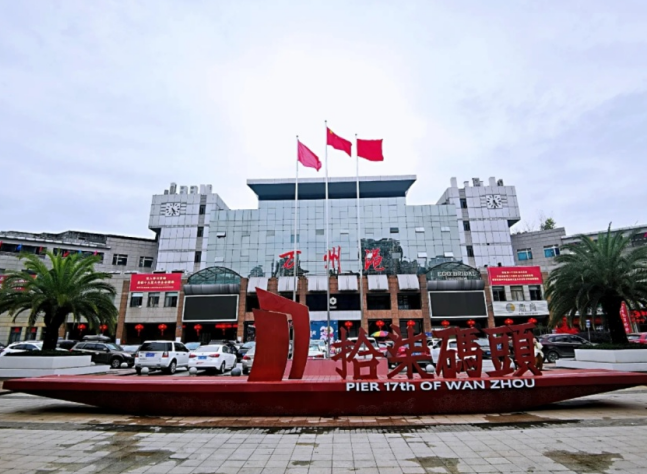
万州因水而兴,万州港是长江十大港口之一。万州1902年辟为通商口岸,1917年设立海关。原万县港务局17号趸船刚好位于杨家街口大梯子,这里被人们习惯称之为“十七码头”。重庆直辖后,万州港成为渝东和三峡库区最大的港口,长江三峡工程蓄水后复建的万州港,成为万州市民和游客心中永远无法忘却的地标。现在这里是三峡平湖旅游区的游客中心,也是大三峡旅游的游客接待中心,内集旅游咨询、休闲娱乐、旅游特色商品展销、水上观光巴士乘坐等功能于一体,能充分满足过境游客及周边市民的休闲、观光、娱乐、购物、餐饮需求。
Wanzhou prospered by virtue of the Yangtze River. Wanzhou Port is one of the top ten ports along the Yangtze River. Wanzhou opened its port in 1902 and established the Customs Office in 1917. Because the 17th pontoon of original Wanxian Port was right under the large stairway of Yangjia Street, people are used to calling it "the 17th Wharf". After Chongqing became a municipality directly governed by the Central Government in 1997, Wanzhou Port is the largest one in east Chongqing and the Three Gorges Reservoir Area. Wanzhou Port, which was rebuilt after the impoundment of the Three Gorges Project on the Yangtze River, has become an unforgettable landmark in the eyes of Wanzhou citizens and travelers. Now it serves as the tourist center of the Three Gorges
Lake City Tourist Area, and also the tourist reception center of the Three Gorges tourism. It integrates tourism consultation, leisure and entertainment, tourism speciality exhibition and sales, sightseeing water bus stop, and can fully meet the demands of leisure, sightseeing, entertainment, shopping, and catering for transit visitors and surrounding citizens.

西山公园始建于1925年,1928年基本建成,初名万县商埠公园,后改为西山公园,沿用至今。公园内现有西山钟楼、古茶花园、库里申科烈士墓园、抗战阵亡将士纪念碑、五洲池、静园等景点。园内古树名木繁多,是重庆建园历史最早的公园之一,曾被住建部、中国公园协会评为中国百家名园之一。公园内有四川山茶、云南山茶、华东山茶、广西金花茶、茶梅等茶花品种600余种5000余株,2016年被国际茶花协会授予“国际杰出精品茶花园”称号。园内的库里申科烈士墓园被命名为“第五批全国重点烈士纪念建筑物保护单位”,列为第一批国家级抗战纪念设施、遗址名录;抗战阵亡将士纪念碑作为抗战遗址,以纪念川军出川抗战牺牲的将士,2009年被市政府列为重庆市文物保护单位。
Xishan Park was originally built in 1925 and basically completed in 1928. At first, it was named as “Wanxian Trading Port Park” and later changed to
Xishan Park, which is still in use today. At present, there are several attractions such as Xishan Bell Tower, Ancient Camellia Garden, Martyr Cemetery of Kulishenko, Monument to the Fallen Soldiers of the Anti-Japanese War, Wuzhou Pond, and Jingyuan Garden. The park is rich in ancient and famous trees, and is one of the earliest parks in the history of Chongqing's park construction. It was once rated as one of “China's 100 Famous Parks” by the Ministry of Housing and Urban-Rural Development and the China Park Association. In the park, there are more than 600 varieties of camellia including Sichuan camellia, Yunnan camellia, east China camellia, Guangxi golden camellia and camellia sasanqua with more than 5,000 plants. In 2016, it was awarded the title of "International Outstanding Camellia Garden" by the International Camellia Association. The Martyr Cemetery of Kulishenko in the park was named as “The 5th Batch of National Key Martyrs' Memorial Protection Units" and was listed among the first batch of national Anti-Japanese War memorial facilities and sites; the Monument to the Fallen Soldiers of the Anti-Japanese War is used as the Anti-Japanese War Site to commemorate those soldiers of the Sichuan Army who sacrificed during the Anti-Japanese War, which was listed among a Chongqing municipal cultural relics protection unit by the municipal government in 2009.

全国重点文物保护单位西山钟楼,又名万县钟楼,始建于1930年,由建筑设计师董炳衡先生设计,武汉营造厂修建。西山钟楼为中西建筑风格的结合,现为砖石钢架混合结构,双层盔顶,通高50.24米,平面呈方形,边长12.86米,占地面积166.15平方米,建筑面积1184.98平方米。底层为厅,厅中央竖高7.7米、边长1.34米的方形石碑,原刻万县拔贡谢仙荘撰文之“处世格言”,20世纪60年代碑面四方改刻毛泽东诗词。西山钟楼设计构思巧妙、特色鲜明,装饰别具一格,是万州乃至重庆的近现代典型建筑,与上海海关钟楼、武汉江汉关钟楼齐名,为长江沿岸三大钟楼之一,具有重要的艺术价值和建筑学研究价值,是万州的标志性建筑。
Xishan Bell Tower, also known as Wanxian Bell Tower, is a state-level cultural relic protection unit. It was founded in 1930, designed by architect Dong Bingheng and built by Wuhan Construction Plant. Xishan Bell Tower is a combination of Chinese and Western architectural style. Now it is a steel-masonry composite structure, with a double-layered helmet roof, reaching a full height of 50.24 meters. Its plane is square, with the edge length of 12.86 meters. It covers 166.15 square meters, and the gross floor area is 1184.98 square meters. The ground floor is designed as a hall, in the middle of which there stands a square pillar stone tablet with the height of 7.7 meters and the edge length of 1.34 meters. The original inscription was the “Life Motto” written by Xie Xianzhuang, a scholar entitled “Bogong” of Wanzhou in the Qing Dynasty. In the 1960s, the inscriptions on the four faces of the tablet were changed to the poems of Mao Zedong. Designed with ingenious conception, distinctive feature and unique decoration, Xishan Bell Tower has become a modern typical architecture in Wanzhou and even in Chongqing municipality at large. It is one of the three major bell towers along the Yangtze River, which is comparable to Shanghai Customs Bell Tower and Wuhan Jianghanguan Bell Tower. Due to its important artistic value and architectural research value, it serves as an urban landmark of Wanzhou.

南门口广场是万州建城的发源地之一,记录着西魏废帝二年至今千百年来万州古城历史演变和政治、经济、军事、文化的发展。明朝万历年间始筑石城,城墙绕城连接东门、西门、南门,南门曾是万州最繁华的水码头。随着三峡工程蓄水,曾经的南门没入水底,复建的南门口广场视线通达,将南北两岸尽收眼帘,与北岸十七码头和南岸三峡移民纪念馆对望。繁华旧忆,南门故里,南门口广场见证了万州千余年的城市变迁,是万州人民的母城记忆。
4. Nanmenkou (South Gate) Square
Nanmenkou (South Gate) Square is one of the birthplaces of Wanzhou City. It records the historical evolution and the political, economic, military and cultural development of Wanzhou ancient city from the Eastern Han Dynasty to the present for thousands of years. In the Ming Dynasty, Wanxian City Wall was started to build around the city, connecting East Gate, West Gate, and South Gate. The South Gate was once the most prosperous wharf in Wanzhou. With the impoundment of the Three Gorges Project, the former South Gate was submerged under the water. The reconstructed Nanmenkou (South Gate) Square has unobstructed sight, offering a panoramic view of the north and south banks, not only facing the 17th Wharf
on the North Bank, also the Three Gorges Migration Memorial on the South Bank. With the memories for past prosperity and former South Gate, the Nanmenkou Square has witnessed the vicissitudes of Wanzhou over a thousand years and has become the people’s attachment to the mother city of Wanzhou.

音乐广场设计元素源自万州传统曲艺—川东竹琴。川东竹琴作为国家级非物质文化遗产,迄今已有200多年历史,是巴蜀传统曲艺之一,蕴含独特历史、艺术与人文价值。广场采用现代技术修建主题音乐廊架,加入万州特色乐器竹琴,运用交互式地面声光设备,可产生竹琴等乐器的声音。广场占地2.8万㎡,有水幕电影、音乐喷泉、旱泉等多种设施,其中,音乐喷泉高度达60米。音乐广场建有亲水梯道,游人可以通过广场梯道到江边嬉水游玩。
The designing elements of the music square originate from the Wanzhou's traditional folk art - Chuandong (Eastern Sichuan) Bamboo Strings. As a national intangible cultural heritage, the Bamboo Strings in eastern Sichuan has a history of more than 200 years. It is one of the traditional folk arts of Ba-Shu Culture, and containing unique historical, artistic and cultural values. In the square, a themed music gallery with modern technology is built, which integrates in the element of Wanzhou's characteristic musical instrument - Bamboo Strings. It uses interactive ground acousto-optic equipments to produce the sound such as bamboo strings. The square covers an area of 28,000 square meters, with water screen movies, musical fountains, pave fountains and other facilities. The height of the water from the musical fountain can reach 60 meters. The Music Square is equipped with stairways, through which visitors can go down to the riverside and play with water.

红砂碛位于万州长江二桥下滨江区域,红砂为红色小石,碛乃水中沙滩,因长江水流至此流速放缓而沙石沉淀于此,长年累月形成石滩,故名红砂碛。1939年10月14日,苏联空军志愿队大队长格里戈里·阿基莫维奇·库里申科接到任务,出击日军某军事基地,轰炸完成后遭到日军机群拦截,因机身受重创在沿江返航途中而迫降长江中,迫降地就是当时的聚渔沱(现已淹没)。红砂碛滨水生态公园是以生态学和生态文化为主要理念,结合传统城市公园和主题公园特色而建成的新型城市公园。依据公园地势特征,将173m水位线以上设计为公共游乐区,173m以下为生态护坡区和自然滩涂游乐区,种植水生植物,即使在枯水期也呈现出绿意盎然的生态景观。
is located in the riverside area under the Wanzhou Second Yangtze River Bridge. “Hongsha” means red sand and “qi”
means the sandbeach in the water. Because the river flow slowed down here, sand and rocks had been deposited for countless years, therefore, the sandbeach formed and was named “Hongshaqi”. On October 14, 1939, a captain of Soviet flight brigade, Grigory Kulishenko received a mission to attack a Japanese military base. When flying over Wuhan, they were intercepted by a Japanese aircraft group. On the way back along the river, as his fuselage suffered heavy damage,he made a crashed landing on the river,and the site was former Juyutuo (now submerged). Hongshaqi Waterfront Ecological Park
is a new type of urban park focusing on the main concepts of ecology and ecological culture, combining the characteristics of traditional urban parks and theme parks. According to the topographic characteristics of the park, the area above 173m of water altitude is designed as a public play area, and the area below 173m is an ecological slope protection area and a natural beach play area. Aquatic plants are planted to present a green ecological landscape even in the dry season.
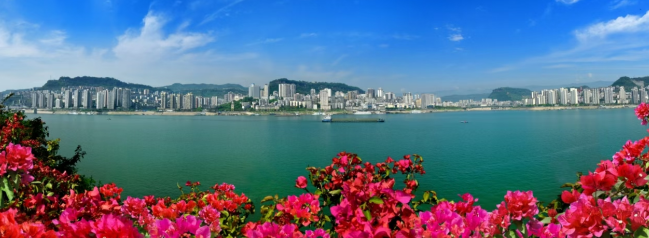
南滨公园位于长江万州段南岸江南新区江畔,北望太白岩,南临毡帽山,上起联合坝,下至密溪沟,公园全长11.68公里,已建成的上段和中段长7.43公里,为滨江带状公园,绿化率达72.28%。公园临江设宽6米的观景通道,内有宽2.1米的彩色休闲步道,让市民亲水、观景、健身,园内配套了景观小品、艺术灯光、智慧互动导览设备、清凉喷雾系统等,打造出曲径通幽、园艺人文的游览意境。公园栽植有黄葛树、桂花、银杏、中山杉、金丝垂柳、高山榕、香樟等乔木3100株,桂花球、茶花、花石榴等花灌木2718株,斑竹4万株,杜鹃、石楠、茶梅、金边六月雪等地被1.3万㎡,二月草、麦冬、葱兰等草被植物6.7万㎡。
7. South Riverside Park
South Riverside Park is located in the Jiangnan New Area on the south bank of the Yangtze River in Wanzhou. It faces Taibai Mountain
to the north, and lies Zhanmao Mountain
on the south. Its upper section starts from Lianheba and lower section gets to Mixigou, with total length of 11.68 kilometers. The completed upper and middle sections are 7.43 kilometers long, presenting a riverside belt park with a greening rate of 72.28%. In the park, there is a 6-meter-wide sightseeing passageway along the river, on which, a 2.1-meter-wide colorful leisure trail is paved, in order to provide citizens with water-playing, sightseeing and exercising convenience. The park is equipped with landscape sketches, artistic lighting, smart interactive guide equipments, and cooling spray system, etc., which create a tourist artistic conception of winding paths with a horticulture touch. The park is planted with 3,100 trees such as ficus virens, osmanthus, ginkgo, Zhongshan fir, golden weeping willow, ficus altissima and camphor, etc. There are 2,718 flowering shrubs such as sweet-scented osmanthus balls, camellia and pomegranate, 40,000 bamboos, and 13,000 square meters’ coverage of rhododendrons, heathers, camellia sasanqua, serissa japonica and other ground covers. The area of February grass, ophiopogon japonicus, zephyranthes candida and other grasses covers 67,000 square meters.

三生有幸广场与西山钟楼隔江相望,面积约1.5万㎡。广场内标志性建筑是“三生石”,据苏轼《僧圆泽传》记载,唐代僧人圆泽与名士李源同游三峡,圆泽在万州投胎转世;李源千里赴约,与再生的圆泽相会于杭州。前世、今生的缘,今生、来世的情,广为流传。“三生缘”景观墙镌刻有三生有幸典故和诗词,是青年男女“缘定三生”见证之地。
8. Sanshengyouxing Square
Sanshengyouxing Square faces Xishan Bell Tower across the river, covering an area of about 15,000 square meters. The iconic building in the square is the "Sansheng Stone". According to Su Shi's Monk Yuanze Biography, the Tang Dynasty monk Yuanze traveled to the Three Gorges with the celebrity Li Yuan, and Yuanze was reincarnated in Wanzhou; and then Li Yuan went to the appointment to meet the reborn Yuanze
in Hangzhou of thousands miles away. This story describing the luck
of the past and present lives; and the affection of this life and future are widely spread. The "Sanshengyuan" landscape wall is engraved with the allusions and relevant poems, thus it is becoming the witness for “love lasting past, present and future lives” of young couples.

樱花渡公园位于万州牌楼长江大桥南桥头,占地总面积331.8亩,定位为“自然生态、运动时尚”的生态型体育公园。公园建有门球场、五人制足球场、篮球场、羽毛球场、网球场等体育运动场地。园内充分利用崖壁资源,复建万州古八景之一“岑洞水帘”,并结合桥下空间,打造库区首家沉浸式灯光表演秀。公园栽植松月樱、阳光樱、郁金樱、冬樱、大寒樱、十月樱等60余种樱花,共计约4000株;辅以桂花、香樟、黄葛树、蓝花楹等其他乔木,配置开花、色叶亚乔和灌木、地被、花卉,形成乔灌草上中下的植物层次,营造色彩、姿态丰富的植物景观。公园以滨江生态为出发点,打造集休闲观光、赏花科普、运动健身、文化感受等功能于一体的城市滨江休闲公园。
9. Cherry Blossom Park
Cherry Blossom Park is located at the south end of Wanzhou Pailou Yangtze River Bridge, covering a total area of 331.8 mu. It is positioned as an ecological sports park of "natural ecology and sports fashion". In the park, there are many sports venues such as gateball court, futsal court, basketball court, badminton court, tennis court. By making full use of cliff resources, the “Water Curtain of Cengong Cave”, one of the eight ancient sceneries in Wanzhou is rebuilt here, and the space under the bridge is created as the first immersive light show in the reservoir area. The park is planted with more than 60 kinds of cherry blossoms, including Songyue cherry blossom, Sunshine cherry blossom, Yujin cherry blossom, Winter cherry blossom, Dahan cherry blossom, and October cherry blossom, totaling about 4000 plants, and is supplemented by other trees such as sweet-scented osmanthus, camphor, ficus virens, jacaranda, and medium-sized trees of colorful leaves and blossoms, shrubs, ground covers, flowers, forming upper, middle, lower layers of arbor, shrub and grass, therefore, the plant landscapes are colorful and diverse. Because of focusing on the riverside ecology, it is created as an urban riverside leisure park integrating leisure and sightseeing, flower and popular science, sports and fitness, and culture and experience.

万县旧城墙原位于苎溪河与长江交汇之处的南门口,属清代石砌城墙。因三峡工程于2014年搬迁复建于此。现全长129.76米,高4.2-6.4米,宽3-13.1米,包括大南门、水门、城墙三部分。明代以前,万县旧城墙一直是土筑城墙,明万历三年(1575年),沿江一带改为石筑城墙。同治九年(1870年)万县遭遇大水,城墙损毁严重,后历时四年修复,现在的万县旧城墙多为当时修复后的城墙。万县旧城墙作为万州城市发展变化的见证者,具有重要的历史文化价值。
10. Wanxian Ancient City Wall
Wanxian Ancient City Wall, a kind of stone block wall of the Qing Dynasty, once was located at “Nanmenkou” (South Gate), serving as the junction of Zhuxi River and Yangtze River. Because of the Three Gorges Project, it was relocated and reconstructed here in 2014. Now it is 129.76 meters in length, 4.2-6.4 meters in height and 3-13.1 meters in width, including three parts: the Great South Gate, the Water Gate and the wall. Before the Ming Dynasty, the ancient city wall of Wanxian was built with earth. In 1575, the 3rd year of Wanli in the Ming Dynasty, the wall along the Yangtze River was rebuilt with stone. In 1861 and 1870, 1st year and 9th year of Tongzhi in the Qing Dynasty, Wanxian encountered floods and the city wall was seriously damaged. Then it took four years to be restored. The majority parts of the present Wanxian Ancient City Wall are those restored at that time. As the witness of developments and changes of the city, Wanxian Ancient City Wall is of important historical and cultural value.

牌楼长江大桥于2014年8月8日动工兴建,2019年5月30日通车。该桥是一座城市跨江双塔斜拉大桥,分别由水上主桥、南北两岸两座倒Y形桥塔及其各立交匝道组成,桥梁主线总长约2.12公里,设计桥型主跨730米。大桥涉水施工深度属国内之最,南主塔立于江水之中,其最大水深达57米。大桥斜拉索异形索面安装属国内首创。桥塔的景观设计既融入了中国元素,又展现出欧式风格。夜景灯光突出“双塔斜拉”这一特色,采用多种照明手法,形成多元立体照明,使桥梁如一架硕大的竖琴屹立于平湖之上。
11. Pailou Yangtze River Bridge
Pailou Yangtze River Bridge was started building on August 8, 2014 and opened to traffic on May 30, 2019. It is an urban cross-river cable-stayed bridge with double towers, consisting of a main bridge over the river, two inverted Y-shaped bridge towers and overpass ramps on the north and south banks. Its total mainline length is 2.12 kilometers, and the main span is 730 meters. The underwater construction depth of the bridge is the deepest in our country, for its south main tower stands amid the river and the maximum depth is 57 meters. The asymmetric cable planes arrangement of the cable-stayed bridge is the first in our country. The landscape design of the bridge towers not only integrates the Chinese elements, but shows the European style. The night view lighting emphasizes the cable-stayed planes and the double towers, and by using a variety of lighting ways it forms a multilayered illumination with a stereoscopic vision, which makes the bridge resemble a huge harp over the lake.


✦ 三峡平…
...
4月12日,渝东北区域无人机应用技能大赛将在万州区大周镇铺垭村铺垭老街震撼开赛!…